At a Glance
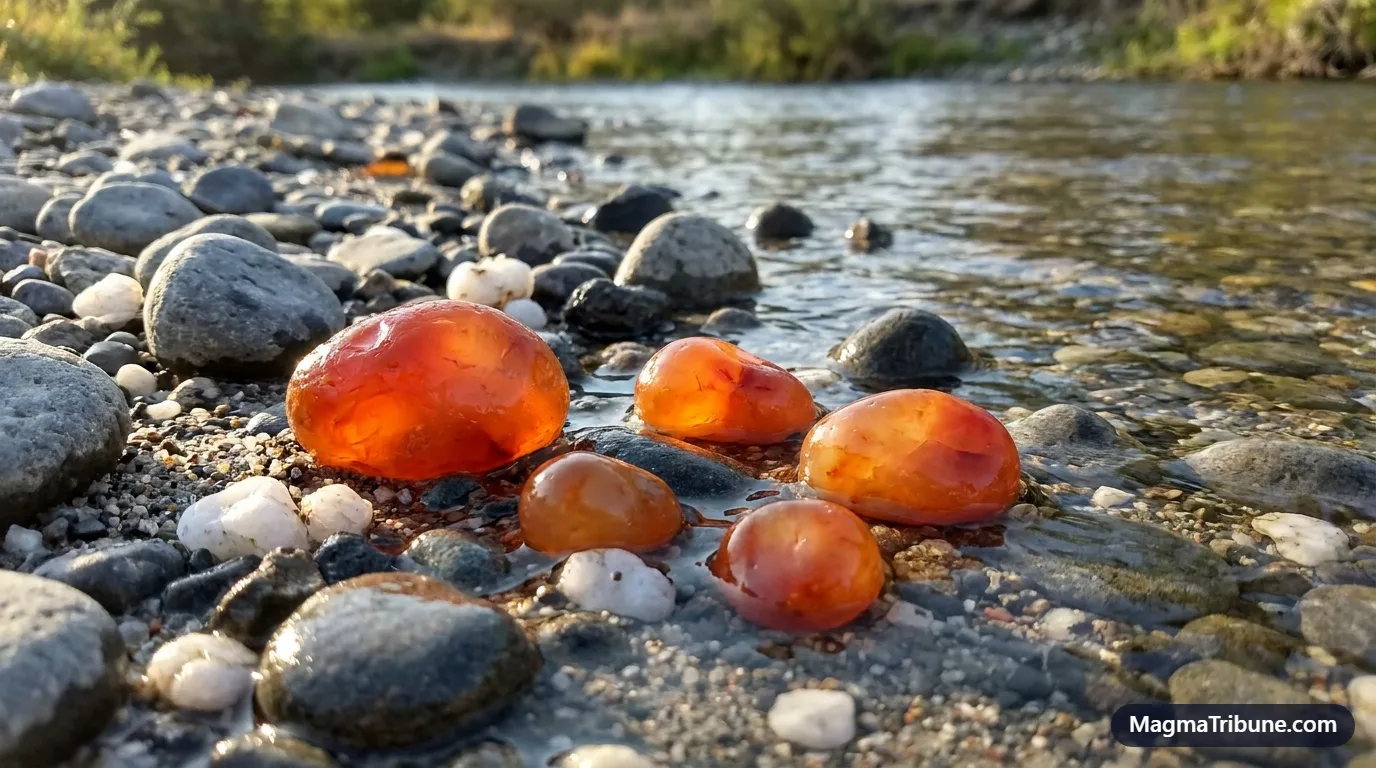
Carnelian is red to orange, translucent chalcedony: microcrystalline quartz, SiO2, with hardness 6.5 to 7 and specific gravity 2.58 to 2.64. It forms when silica-rich water fills cavities and cracks in rock with microscopic quartz crystals, and much of it is collected as pebbles from gravel. Light shines through a thin edge, which separates it from opaque red jasper.
- Mineral species
- Quartz (chalcedony, microcrystalline)
- Chemical formula
- SiO₂ (silicon dioxide)
- Mohs hardness
- 6.5–7
- Specific gravity
- 2.58–2.64
- Color and clarity
- Yellow to red, translucent
- Data
- Wikidata (CC0) · USGS Bulletin 1042-G · USGS Natural Gemstones
On this page
- What Is Carnelian?
- Carnelian Explained Simply
- What Gives Carnelian Its Color?
- What Are the Physical Properties of Carnelian?
- How Does Carnelian Form?
- How to Identify Carnelian
- Carnelian vs Jasper vs Agate: What Is the Difference?
- Where Is Carnelian Found?
- What Is Carnelian Used For?
- Going Deeper: Why Chalcedony Is Tougher Than Quartz Crystal
- Practice and Explore More
- Common Misconceptions
- Key Facts
- Quiz
- FAQ
What Is Carnelian?
Carnelian is a reddish, translucent kind of chalcedony. Chalcedony is quartz, SiO2, in a form made of crystals far too small to see, mixed with a little hydrated silica. So carnelian has the same chemistry as a clear quartz crystal; what changes is the size of the crystals and the trace of color.
USGS Bulletin 1042-G, the survey's classic report on U.S. gem stones, lists carnelian among the cryptocrystalline varieties of quartz and describes it as clear, translucent agate ranging in color from yellow to red. The same report treats carnelian and sard as two names for this material. In the gem lists of the USGS publication Natural Gemstones, the spelling cornelian appears alongside sard.
Carnelian sits in our gemstones section because people have cut and polished it for a very long time. In mineral science, though, it is a variety name, like amethyst or agate, not a separate mineral species.
Carnelian Explained Simply
Imagine quartz ground down to grains so tiny that millions fit on a pinhead, then packed back together into a smooth, waxy stone. That is chalcedony. Now add a faint orange tint that lets light glow through it like a slice of orange gelatin. That is carnelian.
Because the tiny grains lock tightly together, carnelian is tough. It does not split into flat pieces, and when it breaks it leaves smooth, curved surfaces, like the inside of a seashell. It is also hard enough to scratch glass.
Hold a thin piece up to a lamp and it glows red or orange. Hold a piece of red jasper the same way and almost no light gets through. That simple light test is the easiest way to tell the two red stones apart.
What Gives Carnelian Its Color?
Carnelian's color comes from small amounts of impurities spread through the silica, not from the quartz itself, which is colorless when pure. USGS explains that the colors of agate, the banded chalcedony family carnelian belongs to, come from small amounts of metallic salts and iron or manganese oxides, and only rarely from nickel, chromium or copper.
The color range USGS gives for carnelian is yellow to red. Paler, yellowish stones grade into orange, and the deepest stones are a warm brownish red. Unlike banded agate, carnelian usually shows fairly even color, or soft clouds of stronger and weaker tint, rather than sharp concentric stripes.
Translucency is part of the definition. Carnelian lets light pass through thin edges. When red silica is packed with so many impurities that it becomes opaque, geologists call it jasper instead; USGS describes red jasper as chalcedony colored by minute inclusions of hematite. For more on why the same mineral can show many colors, see our guide to mineral color.
What Are the Physical Properties of Carnelian?
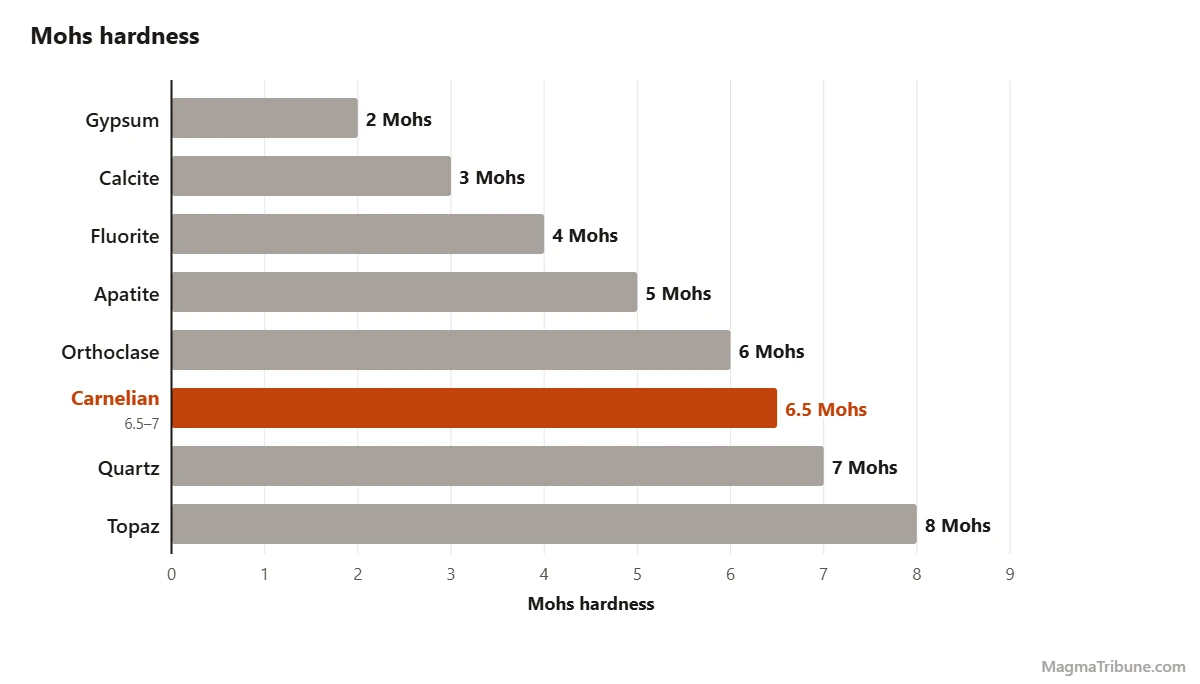
Carnelian shares the properties of the chalcedony family. It rates 6.5 to 7 on the Mohs hardness scale, so it scratches glass and a steel knife blade. Its specific gravity of 2.58 to 2.64 is slightly lower than the 2.65 of a clear quartz crystal.
That small difference has a structural cause. USGS describes the cryptocrystalline quartz varieties as a mixture of minute quartz particles and hydrated, amorphous silica. The tiny pores and water-bearing silica between the crystals make the stone a little lighter than a solid single crystal.
Carnelian has no cleavage and breaks with a smooth, curved conchoidal fracture. USGS lists quartz luster as vitreous, sometimes greasy, and describes agate luster as sometimes waxy, which matches the soft, waxy glow of polished carnelian. Wikidata records the trigonal crystal system of quartz for carnelian; the crystals are simply microscopic.
| Property | Value |
|---|---|
| Mineral species | Quartz, as microcrystalline chalcedony |
| Chemical formula | SiO₂ (silicon dioxide) |
| Structure | Minute quartz particles mixed with hydrated amorphous silica |
| Mohs hardness | 6.5–7 |
| Specific gravity | 2.58–2.64 |
| Crystal system | Trigonal (microscopic crystals) |
| Luster | Waxy to vitreous |
| Cleavage and fracture | No cleavage; conchoidal fracture |
| Transparency | Translucent |
| Color | Yellow to red |
| Other name | Sard (cornelian is an older spelling) |
| Birthstone | July (with ruby) |
| Wikidata ID | Q324369 |
| Source: Wikidata Q324369 (CC0, retrieved 2026-10): hardness, crystal system · USGS Bulletin 1042-G, Gem Stones of the United States (retrieved 2026-10): formula, structure, specific gravity, luster, fracture, color, transparency, sard · USGS Natural Gemstones, GIP 7000029 (retrieved 2026-10): cornelian spelling, July birthstone | |
How Does Carnelian Form?
Carnelian forms the way other chalcedony does: from silica dissolved in water that seeps through rock and slowly deposits its load in open spaces. USGS describes agate, the group that includes carnelian, as a secondary mineral that fills seams, fissures, veins and cavities in rock, and that can also grow as dripping stalactitic forms and rounded, grape-like crusts.
- Silica dissolves. Groundwater picks up silica from volcanic glass, weathered silicate minerals or older quartz.
- Water finds open space. Gas bubbles in lava flows, cracks and other cavities give the silica-bearing water somewhere to collect.
- Microscopic quartz grows. Silica settles out layer by layer as very fine crystals mixed with hydrated silica, building chalcedony from the walls inward.
- Iron adds color. Small amounts of iron oxides carried by the water tint the silica yellow, orange or red.
- Erosion frees the stones. Because chalcedony is hard and tough, it outlasts the rock around it and ends up as pebbles in streams and gravels.
That last step matters for collectors. USGS notes that most agates are found in gravel deposits, and several of the carnelian localities it lists are rivers and creeks. The same cavity-filling process also lines geodes, and our page on how gemstones form places chalcedony among the gems deposited by water.

How to Identify Carnelian
You can recognize most carnelian with a light source, a glass plate and a close look at broken surfaces. Our mineral identification guide explains each test.
- Check translucency. Shine a flashlight through a thin edge. Carnelian glows orange to red; jasper stays dark because it is opaque.
- Scratch test. Carnelian, at 6.5 to 7, scratches glass. Red glass imitations are softer, and red carbonate stones are far softer.
- Look at the fracture. Chips show smooth, curved conchoidal surfaces and no flat cleavage faces.
- Check the luster. A broken or polished surface looks waxy to glassy.
- Look for bands. Carnelian usually has even or cloudy color. Sharp concentric bands mean the stone is better described as red banded agate.
- Acid test. A drop of dilute acid does nothing to carnelian. Red calcite or other carbonates fizz; see our acid test for minerals.
Weighing a stone in air and in water gives its specific gravity, which should land near 2.6 for carnelian. Our specific gravity calculator does the arithmetic, and the specific gravity of minerals page explains the method.
Carnelian vs Jasper vs Agate: What Is the Difference?
Carnelian, jasper and agate are all chalcedony, so they share the same chemistry, hardness range and fracture. The differences are about light and pattern, which is why the table below compares how each stone looks rather than what it is made of.
Carnelian is translucent and yellow to red, usually without sharp banding. Jasper is opaque and most often red because of minute hematite inclusions. Agate is translucent like carnelian but shows concentric bands of color; USGS actually describes carnelian as a kind of agate, so some banded red stones fall on the line between the two names.
Other close relatives include onyx, with straight parallel bands, and chrysoprase, the apple-green chalcedony colored by nickel. Green chalcedony with red spots is bloodstone.
| Stone | Light through a thin edge | Typical color | Pattern | Mohs hardness | Specific gravity |
|---|---|---|---|---|---|
| Carnelian | Translucent | Yellow to red | Even or cloudy color | 6.5–7 | 2.58–2.64 |
| Jasper | Opaque | Usually red | Solid or mottled | 6.5–7 | 2.58–2.64 |
| Agate | Translucent | Many colors | Concentric bands | 6.5–7 | About 2.6 |
| Bloodstone | Translucent | Dark green with red spots | Spotted | 6.5–7 | About 2.6 |
| Chalcedony (plain) | Translucent | White, gray, blue | Usually one color | 6.5–7 | 2.58–2.64 |
| Source: Our gemstones data (data/minerals.json; Wikidata CC0 for hardness, specific gravity verified against USGS Bulletin 1042-G, retrieved 2026-10) · colors, transparency and patterns: USGS Bulletin 1042-G · our classification | |||||

Where Is Carnelian Found?
Carnelian occurs wherever chalcedony formed in iron-bearing settings, especially in and around old lava flows, and it is usually collected from gravels downstream. USGS Bulletin 1042-G names several U.S. localities. In California it lists Jenne Creek at Hornbrook. In Oregon it lists the Salmon River and Cedar Creek near Toledo, and the Nehalem River at Vernonia.
The bulletin's locality table also lists carnelian with jasper at Austin Bluffs near Colorado Springs, Colorado. Many of these are stream settings, which fits the general USGS observation that chalcedony survives erosion and accumulates in gravel.
Agate and chalcedony in general are widespread in the western states. USGS names central and eastern Oregon, Montana, Wyoming, Arizona, Texas, New Mexico, Washington, Utah and Illinois as the most important agate-producing states in its survey, and our agate page covers those deposits.
What Is Carnelian Used For?
Carnelian is used as an ornamental and carving stone. USGS notes that the cryptocrystalline quartz varieties, such as agate and jasper, are used for ornamental purposes, and that they are tougher than coarse quartz crystals because they are built of many closely bound small crystals. That toughness lets carvers shape beads, cabochons and small engraved pieces without the stone splitting.
Carnelian also appears on traditional birthstone lists. The USGS publication Natural Gemstones pairs carnelian with ruby for July, a pairing our birthstones page explains. Birthstone lists are cultural traditions; they say nothing about the mineral's properties.
Scientifically, carnelian is useful as a teaching example. It shows that one mineral, quartz, can look completely different depending on crystal size and trace impurities, which is the theme of our types of gemstones overview.
Going Deeper: Why Chalcedony Is Tougher Than Quartz Crystal
Hardness and toughness are different properties. Hardness measures resistance to scratching, and carnelian's 6.5 to 7 is about the same as a quartz crystal's 7. Toughness measures resistance to breaking, and here chalcedony wins.
A single quartz crystal is one continuous structure, so a crack that starts can run straight through it. In carnelian, a crack has to cross countless tiny crystals that point in different directions and are cemented by hydrated silica. Each boundary deflects or absorbs some of the crack's energy. USGS sums this up by noting that the cryptocrystalline varieties are tougher because they are composed of many closely bound small crystals and amorphous particles.
The same structure explains the slightly lower density and the waxy luster. Light scatters at the many crystal boundaries, giving the soft glow rather than the sharp sparkle of a faceted quartz crystal. Our cleavage and fracture page shows how structure controls the way minerals break.
Practice and Explore More
Try the hardness test yourself with our Mohs scratch test at home, then practice with the printable minerals worksheets. Younger learners can start with minerals for kids.
To keep exploring the quartz family, compare carnelian with chalcedony in general, with banded agate and with opaque jasper, or see how quartz differs from calcite in quartz vs calcite.
Common Misconceptions
Myth: Carnelian is its own mineral.
Science: Carnelian is a variety of chalcedony, which is microcrystalline quartz. Its chemistry is the same as rock crystal: SiO2.
Myth: All red chalcedony is carnelian.
Science: Only translucent red to orange chalcedony is called carnelian. Opaque red chalcedony is jasper, and sharply banded red stones are usually called agate.
Myth: Carnelian is soft because it looks waxy.
Science: The waxy look comes from light scattering at microscopic crystal boundaries. Carnelian is 6.5 to 7 on the Mohs scale and scratches glass.
Key Facts
- Carnelian is translucent, yellow-to-red chalcedony, a microcrystalline variety of quartz with the formula SiO2.
- Carnelian rates 6.5 to 7 on the Mohs scale, so it scratches glass and steel.
- Its specific gravity of 2.58 to 2.64 is slightly below the 2.65 of a clear quartz crystal.
- USGS describes carnelian as clear, translucent agate ranging from yellow to red, also called sard.
- Carnelian is translucent; similar red silica that is opaque is called jasper.
- Chalcedony colors come from small amounts of metallic salts and iron or manganese oxides, according to USGS.
- USGS lists carnelian localities along creeks and rivers in California and Oregon and at Austin Bluffs, Colorado.
- The USGS publication Natural Gemstones pairs carnelian with ruby as a July birthstone.
Quick Quiz: How Well Do You Know Carnelian?
7 questions. Tap an answer to check it.
Carnelian is a variety of which mineral?
Carnelian is chalcedony, the microcrystalline form of quartz.
What separates carnelian from red jasper?
Light passes through thin carnelian but not through jasper.
What is the Mohs hardness of carnelian?
Like other chalcedony, carnelian rates 6.5 to 7.
Which other name does USGS give for carnelian?
USGS Bulletin 1042-G uses carnelian or sard for translucent yellow-to-red agate.
Why is carnelian slightly lighter than a quartz crystal?
Pores and hydrated silica lower its specific gravity to 2.58–2.64.
How does carnelian break?
Chalcedony has no cleavage and breaks conchoidally.
Where is much carnelian collected?
Hard, tough chalcedony survives erosion and collects in gravels.
Frequently Asked Questions
What is carnelian?
Carnelian is a translucent, yellow-to-red variety of chalcedony, the microcrystalline form of quartz. Its formula is SiO2, it rates 6.5 to 7 on the Mohs scale and has a specific gravity of 2.58 to 2.64. USGS describes it as clear, translucent agate ranging from yellow to red, also known as sard.
Is carnelian a mineral or a rock?
Carnelian is a variety of the mineral quartz. It is made of microscopic quartz crystals with some hydrated silica, a form called chalcedony. Because it is essentially one mineral, geologists treat it as a mineral variety rather than a rock, much like amethyst or agate.
What gives carnelian its red color?
Small amounts of impurities spread through the silica give carnelian its color. USGS attributes the colors of agate and related chalcedony mainly to metallic salts and iron or manganese oxides. Pure quartz is colorless, so the yellow, orange and red tints all come from these traces.
How does carnelian form?
Silica dissolved in groundwater seeps into cavities, seams and cracks in rock, often in old lava flows, and slowly deposits microscopic quartz crystals. Traces of iron oxide tint the silica red to orange. Later, erosion frees the hard, tough stones, and many end up as pebbles in stream gravels.
What is the difference between carnelian and jasper?
Both are red chalcedony, but carnelian is translucent and jasper is opaque. Shine a light through a thin edge: carnelian glows orange to red, jasper stays dark. USGS describes red jasper as chalcedony colored by minute hematite inclusions, dense enough to block light.
What is the difference between carnelian and sard?
USGS Bulletin 1042-G treats carnelian and sard as names for the same material, translucent yellow-to-red agate. The USGS gem list in Natural Gemstones names cornelian and sard side by side. Either way, both names describe the same mineral: translucent, iron-tinted chalcedony, SiO2.
How hard is carnelian?
Carnelian rates 6.5 to 7 on the Mohs hardness scale, about the same as quartz. It scratches glass and steel, which sit near 5.5 to 6.5 on the National Park Service hardness chart. Its fine-grained structure also makes it tougher than a single quartz crystal.
Where is carnelian found in the United States?
USGS Bulletin 1042-G lists carnelian at Jenne Creek near Hornbrook, California; the Salmon River and Cedar Creek near Toledo, Oregon; the Nehalem River at Vernonia, Oregon; and Austin Bluffs near Colorado Springs, Colorado. Many finds are pebbles in river gravels.