
At a Glance
The hydrosphere is the total water of Earth: oceans, ice, groundwater, lakes, rivers, soil moisture and water vapor. The USGS estimates about 332.5 million cubic miles of water, 96.5 percent of it in the oceans. Of the 2.5 percent that is fresh, 68.7 percent is frozen in ice and snow and 30.1 percent is groundwater, leaving under 1.5 percent in lakes, rivers and the air.
On this page
What Is the Hydrosphere?
Earth scientists split the planet into four connected spheres: the rocky geosphere, the air of the atmosphere, the living biosphere and the watery hydrosphere. The hydrosphere includes every drop of water in every form: liquid water in oceans, lakes, rivers and underground, solid water in glaciers and permafrost, and invisible water vapor in the air. Frozen water is often treated as its own sub-sphere, the cryosphere.
The word comes from the Greek hydor, water. What makes Earth unusual in the Solar System is not just that it has water, but that its surface temperature lets water exist as a liquid, a solid and a gas at the same time. Viewed from space, the USGS notes, water in liquid and frozen form covers about 75 percent of the surface.
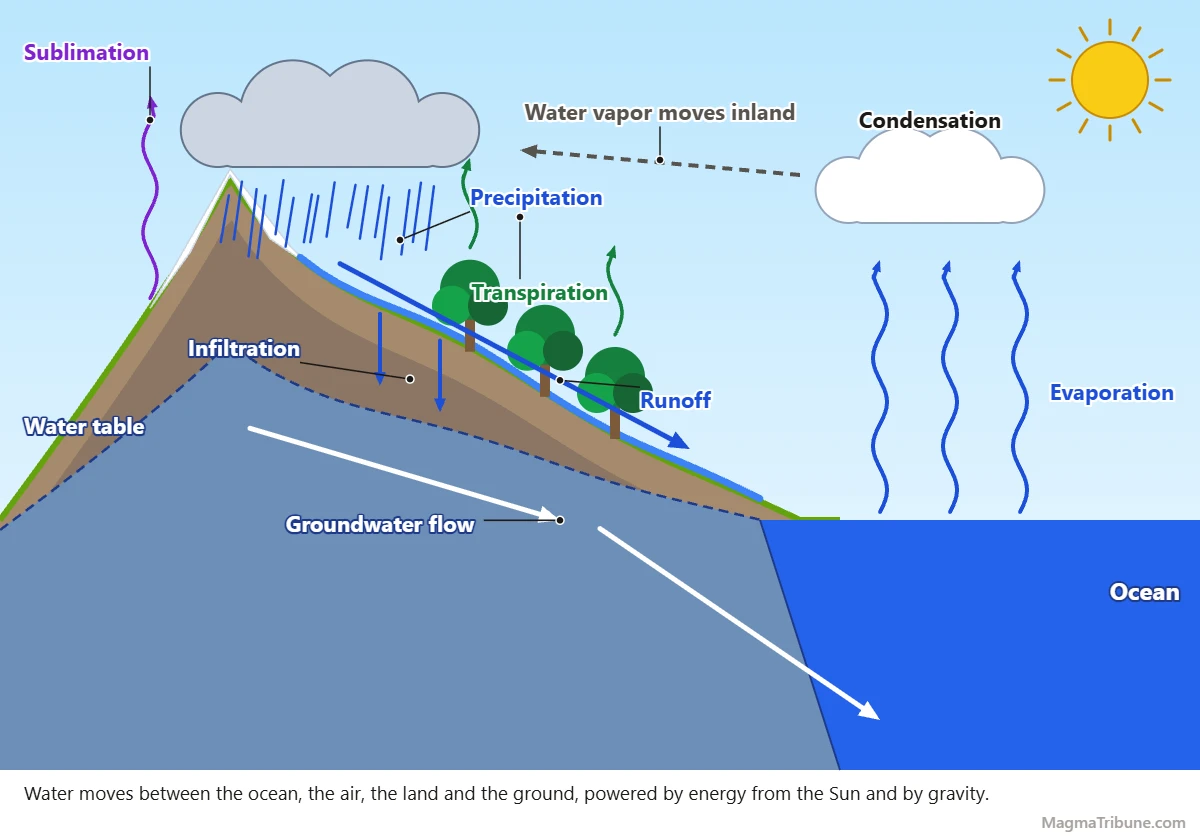
None of this water stays put. Heated by the Sun and pulled by gravity, it moves endlessly between the ocean, the air and the land in the water cycle. Along the way it shapes landscapes, carries sediment, dissolves minerals and supports every living thing.
Where Is Earth's Water?
The USGS Water Science School uses a classic estimate of global water by the hydrologist Igor Shiklomanov. It shows how lopsided the distribution is:
- Oceans, seas and bays: 96.54 percent of all water, about 321 million cubic miles, all of it salty. Our oceans guide covers that water in depth.
- Ice caps, glaciers and permanent snow: 1.74 percent, but 68.7 percent of all freshwater. See glaciers and ice.
- Groundwater: 1.69 percent, a little under half fresh and the rest saline. Fresh groundwater is 30.1 percent of all freshwater; see groundwater and aquifers.
- Lakes: 0.013 percent, split almost evenly between fresh and saline lakes.
- Soil moisture, the atmosphere, swamps, rivers and living things together hold less than 0.01 percent.
The rivers that people depend on most hold just 2,120 cubic kilometers, about 0.0002 percent of Earth's water. They matter far more than their volume suggests because the water in them is constantly replaced. The full breakdown is on our page about the distribution of water on Earth, and how much of the Earth is water answers the question in a few lines.
| Water source | Volume (km³) | Volume (mi³) | Share of freshwater | Share of all water |
|---|---|---|---|---|
| Oceans, seas and bays | 1,338,000,000 | 321,000,000 | n/a (saline) | 96.54% |
| Ice caps, glaciers and permanent snow | 24,064,000 | 5,773,000 | 68.7% | 1.74% |
| Groundwater (fresh and saline) | 23,400,000 | 5,614,000 | 30.1% (fresh part) | 1.69% |
| Ground ice and permafrost | 300,000 | 71,970 | 0.86% | 0.022% |
| Lakes (fresh and saline) | 176,400 | 42,320 | 0.26% (fresh part) | 0.013% |
| Soil moisture | 16,500 | 3,959 | 0.05% | 0.001% |
| Atmosphere | 12,900 | 3,095 | 0.04% | 0.001% |
| Swamp water | 11,470 | 2,752 | 0.03% | 0.0008% |
| Rivers | 2,120 | 509 | 0.006% | 0.0002% |
| Biological water | 1,120 | 269 | 0.003% | 0.0001% |
| Source: USGS Water Science School, Where Is Earth's Water? (data: Igor Shiklomanov, 1993, in Gleick, Water in Crisis), retrieved 2026-10; percents are rounded and do not add to 100 | ||||

How Much of Earth's Water Is Fresh?
Only about 2.5 percent of Earth's water is freshwater, and most of that is hard to reach. More than two-thirds is frozen, mainly in the ice sheets of Antarctica and Greenland, and almost a third is groundwater, much of it deep underground.
The freshwater in lakes, rivers, swamps, soil and the air is a sliver of a sliver: in the USGS table, fresh lakes hold 0.26 percent of freshwater and rivers 0.006 percent. That is why groundwater pumped from aquifers and water stored behind dams are so important for drinking water and farming. It is also why seawater, though abundant, is not a simple answer: why you can't drink ocean water explains the salt problem.
How Does Water Move Around the Planet?
The water cycle connects every part of the hydrosphere. The USGS estimates that about 90 percent of the moisture in the atmosphere comes from water evaporating from oceans, seas, lakes and rivers, and most of the rest from plants. Once evaporated, a water molecule spends about 10 days in the air before it condenses into cloud droplets and falls back as precipitation.
Rain that lands on the continents takes one of several paths. Some soaks into the soil by infiltration and recharges groundwater through aquifer recharge; some flows over the surface as runoff into streams; and some is pulled up by plant roots and released by transpiration. Gravity eventually brings nearly all of it back to the sea.
How long water stays in one place varies hugely. Water in a river may move on within days or weeks, while deep groundwater and the ice at the bottom of the Antarctic Ice Sheet can stay put for thousands of years.
What Are the Main Bodies of Fresh Water?
On land, freshwater collects in a few kinds of places, each with its own hub:
- Rivers and streams drain the land toward the sea. The longest in our data, the Nile, runs 6,650 kilometers (4,132 miles), and the Amazon carries more water than any other river. Profiles of each are in major rivers of the world.
- Lakes and wetlands store water in basins. The Caspian Sea is the largest lake by area at 386,400 square kilometers, while Lake Baikal holds the most freshwater of any single lake, about 23,600 cubic kilometers. See major lakes of the world.
- Groundwater fills the pores and cracks of rock and sediment below the water table, in layers called aquifers, and returns to the surface at springs.
- Waterfalls mark places where a river drops over a cliff of resistant rock, such as Angel Falls and Niagara Falls.
| Record | Holder | Value |
|---|---|---|
| Longest river | Nile River | 6,650 km (4,132 mi) |
| Second-longest river | Amazon River | 6,400 km (3,977 mi) |
| Largest discharge | Amazon River | 209,000 m³/s at the mouth |
| Longest river in Asia | Yangtze River | 6,300 km (3,915 mi) |
| Largest lake by area | Caspian Sea | 386,400 km² |
| Largest freshwater lake by area | Lake Superior | 82,100 km² |
| Largest lake by volume | Caspian Sea | 78,700 km³ |
| Largest freshwater lake by volume | Lake Baikal | 23,615 km³ |
| Combined area of the Great Lakes | Great Lakes | 244,160 km² (94,250 mi²) |
| Source: Wikidata (CC0), retrieved 2026-10-12, via our rivers and lakes datasets; records computed by us across the 32 rivers and 23 lakes in those datasets; Great Lakes areas from NOAA GLERL (retrieved 2026-10); miles converted from km | ||
How Do Scientists Measure Earth's Water?
Hydrologists measure water where it flows and where it is stored. The USGS has gauged rivers since 1889, when it installed its first streamgage on the Rio Grande in New Mexico, and it now operates more than 8,200 continuous-record streamgages across the United States. Each one records the height of the water every 15 minutes, and periodic measurements convert that height into stream discharge, the volume flowing past each second.
Below ground, wells track the level of the water table. From orbit, satellites measure soil moisture, snow cover, ice thickness and even tiny changes in Earth's gravity caused by water moving between oceans, ice and aquifers. Together these records show how much water each part of the hydrosphere holds and how quickly it is changing.
Where Should You Start? A Water on Earth Learning Path
Our hydrosphere guides are organized into seven sections. This order moves from how water travels to where it collects:
- The water cycle: evaporation, condensation, transpiration, infiltration, runoff and where water is stored.
- Rivers and streams: how rivers form, their parts, watersheds, meanders and discharge.
- Major rivers of the world: from the Nile and Amazon to the Mississippi and Mekong.
- Groundwater and aquifers: water tables, porosity, wells and springs.
- Lakes and wetlands: how lakes form, lake types and wetlands.
- Major lakes of the world: the Great Lakes, Baikal, Victoria and more.
- Waterfalls: how they form and the most famous falls.
For the classroom, start with our water cycle worksheets and freshwater and saltwater worksheets; younger readers can begin with rivers for kids.
All Water on Earth (Hydrosphere) (7)


Key Facts
- The USGS estimates Earth holds about 332.5 million cubic miles (about 1.39 billion cubic kilometers) of water.
- About 96.5 percent of Earth's water is in the oceans, seas and bays.
- Only about 2.5 percent of Earth's water is freshwater.
- Ice caps, glaciers and permanent snow hold 68.7 percent of all freshwater, and groundwater holds 30.1 percent.
- Rivers hold only about 0.0002 percent of Earth's water, roughly 2,120 cubic kilometers.
- About 90 percent of the moisture in the atmosphere comes from evaporation from oceans, seas, lakes and rivers.
- A water molecule spends about 10 days in the atmosphere on average after it evaporates.
- The USGS operates more than 8,200 continuous-record streamgages, the first installed on the Rio Grande in 1889.
Frequently Asked Questions
What is the hydrosphere?
The hydrosphere is all of Earth's water in every form and place: the oceans, glaciers and ice sheets, groundwater, lakes, rivers, wetlands, soil moisture and water vapor in the air. It is one of Earth's four main spheres, along with the geosphere, atmosphere and biosphere, and it constantly exchanges water with them through the water cycle.
How much of Earth's water is drinkable?
Only about 2.5 percent of Earth's water is fresh, and most of that is frozen in ice sheets or lies deep underground. Fresh lakes, rivers and swamps hold well under 1 percent of all freshwater. Much of the drinking water people use comes from groundwater and from rivers and reservoirs, and it often needs treatment before it is safe.
Where is most of Earth's freshwater?
Most freshwater is frozen. In the USGS estimate, ice caps, glaciers and permanent snow hold 68.7 percent of all freshwater, mostly in Antarctica and Greenland. Groundwater holds another 30.1 percent. Lakes, rivers, swamps, soil moisture and the atmosphere share the small remainder.
How much water is there on Earth?
The USGS estimates about 332.5 million cubic miles of water, roughly 1.39 billion cubic kilometers. If it were gathered into one ball, that ball would be only about 1,383 kilometers (860 miles) across, small next to the planet, because the oceans are thin compared with Earth's size.
What are the 4 spheres of Earth?
Earth scientists describe four connected spheres: the geosphere (rocks, minerals and the planet's interior), the atmosphere (the layer of air), the hydrosphere (all water) and the biosphere (all living things). Water links them all, for example by weathering rock, forming clouds and being taken up by plants and animals.
Is the amount of water on Earth changing?
The total amount of water on Earth stays almost the same, because water is recycled rather than used up. What changes is where it is stored. In a warmer climate, more water moves from glaciers and ice sheets into the oceans, and the timing of rain, snowmelt and river flow shifts from place to place.


